
Emerging Markets: The Hotbed of Innovation in Financial Services
By: Campbell Clout, Managing Director, GTM Americas & APMEA | June 5, 2024
Emerging markets, especially those in the APMEA (Asia Pacific/Middle East/Africa) region, are slowly becoming vibrant hubs of innovation, showcasing impressive technology and skills that are redefining global standards. While developed nations have long been leaders in this field, the dynamic advancements in developing countries are now capturing the world’s attention.
Financial services companies—banks, NBFCs, and asset finance and leasing organizations—in these regions are not only catching up but also pioneering advancements, challenging traditional notions of innovation leadership.
Look closely and one realizes that this transformation is hinged on two crucial factors – how these companies are acknowledging and adapting to the evolving customer expectations in these regions, and their adept use of technology to overcome long-standing growth barriers. Even the largest organizations from the most developed nations have a lesson or two in adaptability, agility, and the power of technology-led innovation from these growth stories.
The changing face of customer expectations
One of the driving forces behind rapid innovation in emerging markets is the changing expectations of customers. Most of these countries have a significant population of millennials and individuals born in the digital era. For instance, India boasts one of the largest millennial populations in the world, with approximately 34% (440 million) of its people falling into this category. By 2030, millennials and Gen Z will make up 50% of India’s population. In 2022, millennials already accounted for a significant portion of lending product transactions, contributing to 44% of total transactions. The chart below illustrates how Asia, Africa, Australia, and Latin America collectively house over half of the global millennial population.
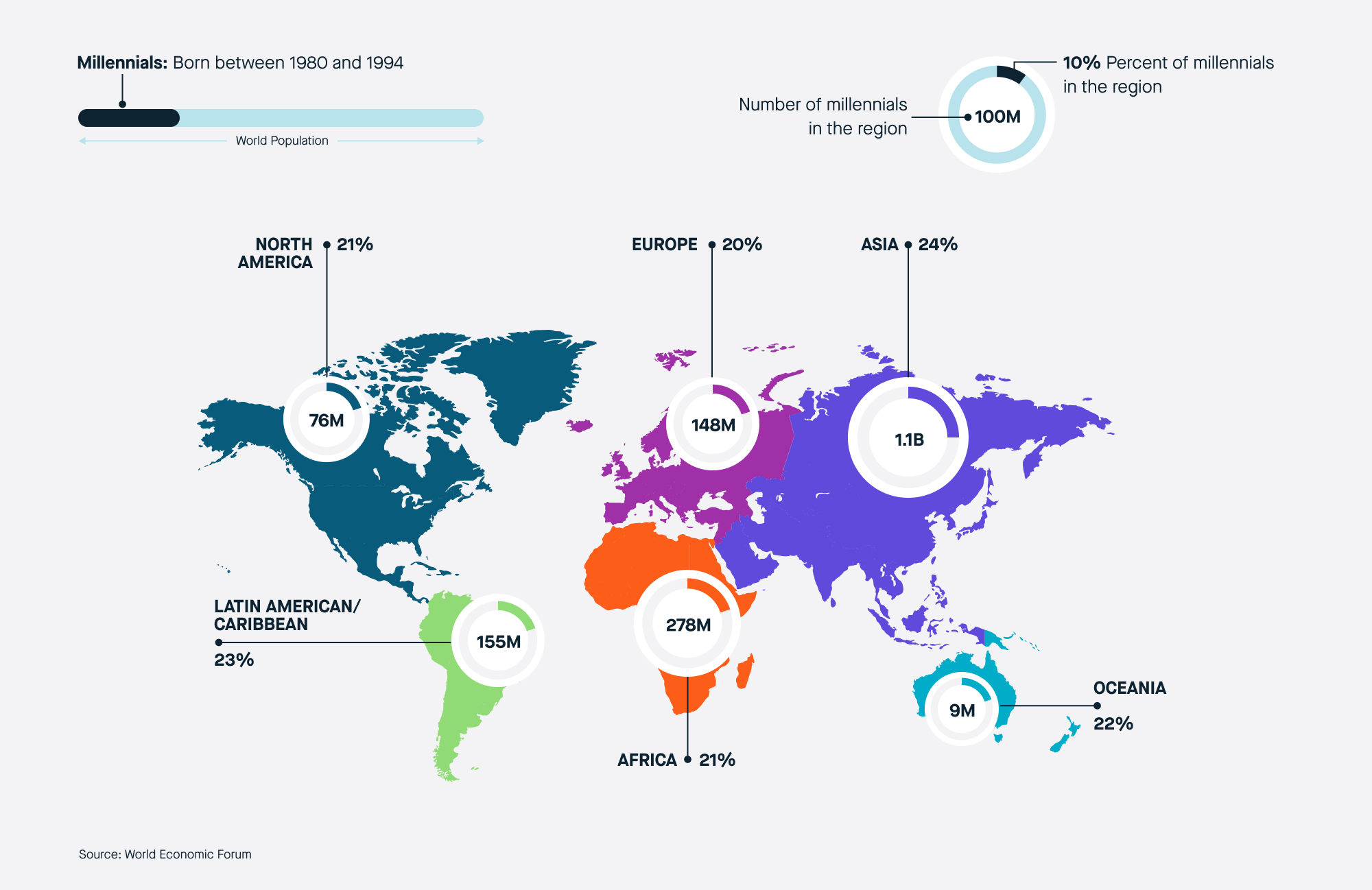
Raised in an era of technological advancements, this generation demands advanced digital financial services tailored to their preferences. They seek omnichannel, digital solutions and instant access to financial products and services, pushing companies to adapt to their evolving needs and preferences through intuitive and user-friendly financial tools.
Moreover, this is also a generation that favors leasing or as-a-service model over the traditional ownership preferences. The rise of leasing and lending in millennial-centric economies is notable, reflecting their comfort with alternative ownership structures. For instance, India’s digital lending market is poised for significant growth, with projections indicating a surge to USD 1.3 trillion by 2030, marking a more than fourfold increase from its current value of USD 270 billion, as highlighted by a report from Inc42 (a technology information platform).
The need to make do with less
Developing countries face unique challenges such as population disparities and resource constraints, necessitating innovative solutions to efficiently serve their vast populations with limited resources, all while overcoming hurdles posed by the lack of necessary infrastructure.
In rural areas lacking traditional banking infrastructure, fintech innovations like mobile banking are bridging gaps and promoting financial inclusion. This imperative for efficiency and cost-effectiveness has spurred a wave of fintech innovations aimed at reaching customers in remote locations and ensuring financial services are accessible to all.
Many governments have acted proactively in response to the urgent need for financial inclusion, especially in developing economies with large unbanked populations. With the rapid rise in internet and smartphone usage, these governments are championing the shift towards digitization and a cashless economy, while ensuring that easy and accessible financial services remain a priority for all citizens.
For example, India has witnessed a substantial governmental drive to encourage digital transactions. The digitization and integration of an individual’s phone number, Aadhar number (Unique ID), bank details, and PAN cards, have made routine tasks for financial institutions like KYC and verifications completely paperless and hassle-free. In Southeast Asia, regulatory bodies like the Central Bank of Malaysia have been pivotal in driving digital banking initiatives, granting digital banking licenses to enhance financial inclusion and fintech innovation and simplifying regulations to reduce the burden on new entrants. Similarly, Indonesia’s digital banking sector received a significant boost in March 2021 through new regulations permitting (almost) complete foreign ownership of local banking service providers. This move aims to streamline processes and reduce bureaucratic hurdles for new entrants.
These initiatives are helping emerging economies to embrace digital reforms, promote healthy competition, enhance consumer protection, and encourage innovation in the financial services sector.

Technology as the great leveler
The widespread adoption of cloud technology and software-as-a-service (SaaS) has democratized access to technology and eliminated entry-level barriers. Now, even small startups in regions like Southeast Asia or Africa can access the same level of technology as their counterparts in developed countries, without requiring substantial up-front financial investments.
Also, these relatively newer organizations, often called digital natives, enjoy a significant advantage. They are not burdened by legacy technology constraints that larger organizations worldwide struggle with. This freedom from legacy systems provides them with a clean slate for experimentation and innovation, enabling them to be more agile and adaptable in scaling their operations to both differentiate their customer experience and compete with the larger players.
-
Mobile connectivity drives fintech innovation: Mobile phones and cheap data connectivity have played a pivotal role in this transformation, catalyzing remarkable economic growth in APMEA. This widespread adoption of mobile technology has been a key driver behind the surge in fintech innovations within these regions.
African nations like Nigeria and Kenya have emerged as fintech hubs, harnessing affordable and accessible technology to engage consumers in unprecedented ways. Kenya stands out for its impressive mobile penetration rates, epitomized by Safaricom’s M-Pesa service. Launched in 2007, M-Pesa operates as a mobile bank, facilitating transactions even without internet access. With a network of 110,000 agents spanning seven countries, M-Pesa has significantly enhanced financial inclusion, with 83% of Kenyans now having access to basic financial services, compared to just 26% in 2006.
-
Leading the digital wave: In the APMEA region, countries are spearheading the charge towards increased digitization and fintech adoption. India stands out as a frontrunner in the digital payments landscape, showcasing innovations such as paperless lending, mobile banking, and secure payment gateways. The success of India’s Unified Payments Interface (UPI) system exemplifies this digital revolution, with over 300 million individuals and more than 50 million merchants utilizing UPI for transactions. India’s digital prowess is reflected in its leading the world in digital transactions, accounting for nearly 46% of the global market share.
This trend towards increased digitization is not limited to India alone. Across Southeast Asia, countries like Singapore, Malaysia, and Thailand are actively embracing technology to drive economic growth and innovation. Initiatives such as Singapore’s FinTech Festival and Malaysia’s Digital Economy Blueprint are fostering collaboration and investment in fintech infrastructure. Similarly, countries like United Arab Emirates, Egypt, and South Africa, are making significant strides with a focus on e-commerce, digital banking, and contactless payments.Overall, the rising trend of adopting digital solutions across the APMEA region highlights the transformative impact of fintech on shaping the future of finance and fostering inclusive economic development. (Read more in our blog Digital Payments: Building the Future of Asset Finance with APIs)
-
APIs usher quick, hassle-free innovation: APIs have revolutionized the financial landscape by facilitating collaboration and symbiotic relationships among financial institutions, telecommunications companies, and other industry players. This collaboration streamlines the process of offering customers bundled or joint products and services, enhancing the overall customer experience.
Conventionally, creating and launching a new financial service could take months, relying on resource-intensive solutions of the past. However, collaborating with fintechs through open APIs solves this problem by leveraging existing infrastructure. This means that institutions no longer need to build everything from scratch. Instead, third parties can utilize an institution’s API, bringing their expertise to the table and swiftly creating new products or services in a matter of weeks, if not days.
Consider UPI payments, which operate as an open-source application programming interface (API) atop the Immediate Payment Service (IMPS). UPI transactions account for more than 50% of digital payments, with transactions witnessing a remarkable 121% growth in value and 115% growth in volume between 2019 and 2022. Similarly, numerous banking-as-a-service models, including digital lending, e-wallets, mobile wallets, and Buy Now Pay Later services, rely heavily on APIs, highlighting their critical role in driving innovation and efficiency in the financial sector.
What it means for asset finance companies in the region
Players in developed markets must start paying attention because these innovative companies will soon emerge as competitors. While not necessarily direct competitors, they will raise customer expectations to such a degree that customers will begin to expect the same level of service and innovation from you as well.
Across captive, direct-to-market, or introduced models, end-user expectations are on the rise, extending to both financial partners and customers alike. It has become mandatory to have a meaningful user experience including a modern and user-friendly interface, digital communication, faster credit approval and digital documentation. Integration of AI further amplifies personal journeys, enhancing efficiency and user interaction. It’s now a global business imperative for elevating client experiences.
Partnerships between industries to launch joint products, rather than an everyone-does-everything approach, should also be examined; not with disdain at having to erode an existing brand, but with opportunism at identifying an untapped corner.
For example, look at Equitel, a significant player in Kenya’s fintech landscape. They are a telecom-banking hybrid resulting from the collaboration between Equity Bank Kenya Limited and global communication giant Airtel. By deploying agents across Kenya, including remote areas, Equitel swiftly captured 22% of the mobile money market within five years of its establishment, underscoring the effectiveness of a locally focused strategy in driving financial inclusion and innovation.
The urgency of replacing outdated legacy technology is now glaringly obvious to those in the asset finance industry who have delayed it for decades. The pressing question today is: what’s the next step, and who can they rely on? Modern lease management software that focuses on extensibility, configurability, and modularity are essential to tackle these emerging challenges.
Furthermore, emerging markets have taken proactive steps to embrace regulatory reforms and foster innovation. Governments and regulatory bodies acknowledge the potential advantages of a thriving financial services sector and have introduced policies to stimulate competition, improve consumer protection, and create an environment conducive to innovation. By establishing regulatory frameworks that balance the promotion of innovation, the safeguarding of stability, and the preservation of data sovereignty, emerging markets have a fertile ground for financial institutions to explore new ideas and technologies.
The time has now come when the asset finance community will need to drive the next phase of innovation to not only protect its market share but also enhance user experience to match that of the digital payments industry.